Prayer, the lifting of the mind and heart to God, plays an essential role in the life of a devout Catholic. Without a life of prayer, we risk losing the life of grace in our souls, grace that comes to us first in baptism and later chiefly through the other sacraments and through prayer itself (Catechism of the Catholic Church, 2565). Through prayer we enter into the presence of the Godhead dwelling in us. It is prayer which allows us to adore God, by acknowledging his almighty power; it is prayer that allows us to bring our thanks, our petitions, and our sorrow for sin before our Lord and God.
While prayer is not a practice unique to Catholics, those prayers that are called "Catholic" are generally formulaic in nature. That is, the teaching Church sets before us how we ought to pray. Drawing from the words of Christ, the writings of Scripture and the saints, and the guidance of the Holy Spirit, she supplies us with prayers grounded in Christian tradition. Further, our informal, spontaneous prayers, both vocal and meditative, are informed by and shaped by those prayers taught by the Church, prayers that are the wellspring for the prayer life of all Catholics. Without the Holy Spirit speaking through the Church and through her saints, we would not know how to pray as we ought (CCC, 2650).
As the prayers themselves witness, the Church teaches us that we should pray not only directly to God, but also to those who are close to God, those who have the power to intercede upon our behalf. Indeed, we pray to the angels to help and watch over us; we pray to the saints in heaven to ask their intercession and assistance; we pray to the Blessed Mother to enlist her aid, to ask her to beg her Son to hear our prayers. Further, we pray not only on our own behalf, but also on the behalf of those souls in purgatory and of those brothers on earth who are in need. Prayer unites us to God; in doing so, we are united to the other members of the Mystical Body.
This communal.aspect of prayer is reflected not only in the nature of Catholic prayers, but also in the very words of the prayers themselves. In reading many of the basic formulaic prayers, it will become apparent that, for the Catholic, prayer is often meant to be prayed in the company of others. Christ himself encouraged us to pray together: "For wherever two or more are gathered together in my name, there I am in the midst of them" (Matt. 18:20).
Keeping in mind the aforementioned characteristics of Catholic prayer will enable you to appreciate and to understand the prayers listed below. While this list is certainly not an exhaustive one, it will illustrate the different kinds of Catholic prayers that help to form the treasury of prayers in the Church.
Fundamental Catholic Prayers
Sign of the Cross
In the name of the Father, and of the Son, and of the Holy Spirit. Amen.
Our Father
Our Father, who art in heaven, hallowed be thy name; thy kingdom come, thy will be done, on earth as it is in heaven. Give us this day our daily bread and forgive us our trespasses, as we forgive those who trespass against us and lead us not into temptation, but deliver us from evil. Amen.
Hail Mary
Hail Mary, full of grace, the Lord is with thee. Blessed art thou among women and blessed is the fruit of thy womb, Jesus. Holy Mary, mother of God, pray for us sinners now and at the hour of our death. Amen.
Glory Be
Glory be to the Father, and to the Son, and to the Holy Spirit. As it was in the beginning, is now, and ever shall be, world without end. Amen.
Apostles’ Creed
I believe in God, the Father almighty, creator of heaven and earth, and in Jesus Christ, his only Son, our Lord, who was conceived by the Holy Spirit, born of the Virgin Mary, suffered under Pontius Pilate, was crucified, died, and was buried. He descended into hell; the third day he rose again from the dead; he ascended into heaven and is seated at the right hand of the Father; from thence he shall come to judge the living and the dead. I believe in the Holy Spirit, the holy Catholic Church, the communion of saints, the forgiveness of sins, the resurrection of the body, and life everlasting. Amen.
Prayers to Our Lady
The Rosary
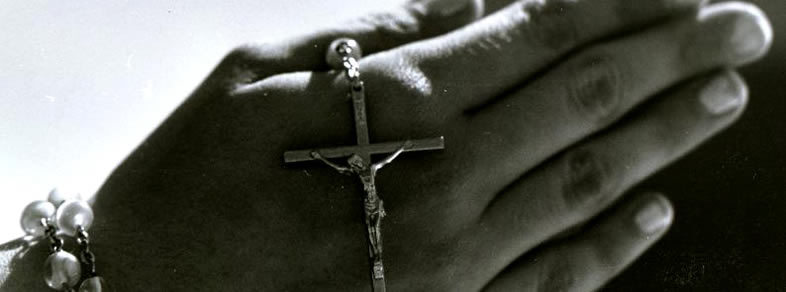
The six fundamental prayers listed above are also part of the Catholic rosary, a devotion dedicated to the Blessed Virgin, the Mother of God. (CCC 971) The rosary consists of fifteen decades. Each decade focuses upon a particular mystery in the life of Christ and his Blessed Mother. It is customary to say five decades at a time, while meditating upon one set of mysteries.
Joyful Mysteries
I. The Annunciation
II. The Visitation
III. The Birth of our Lord
IV. The Presentation of our Lord
V. The Finding of our Lord in the Temple
Sorrowful Mysteries
I. The Agony in the Garden
II. The Scourging at the Pillar
III. The Crowning with Thorns
IV. The Carrying of the Cross
V. The Crucifixion and Death of our Lord
Glorious Mysteries
I. The Resurrection
II. The Ascension
III. The Descent of the Holy Spirit
IV. The Assumption of our Blessed Mother into Heaven
V. The Coronation of Mary as Queen of Heaven and Earth
Hail Holy Queen
Hail, Holy Queen, Mother of mercy, our life, our sweetness, and our hope. To thee do we cry, poor banished children of Eve. To thee do we send up our sighs, mourning and weeping in this vale of tears. Turn then, most gracious advocate, thine eyes of mercy towards us and after this, our exile, show unto us the blessed fruit of thy womb, Jesus. O clement, O loving, O sweet Virgin Mary. V. Pray for us, O holy Mother of God. R. That we may be made worthy of the promises of Christ.
Memorare
Remember, O most gracious Virgin Mary, that never was it known that anyone who fled to thy protection, implored thy help, or sought thy intercession was left unaided. Inspired with this confidence, we turn to thee, O Virgin of virgins, our Mother. To thee we come, before thee we stand, sinful and sorrowful. O Mother of the Word Incarnate, do not despise our petitions, but in thy mercy hear and answer us. Amen.
The Angelus
The angel of the Lord declared unto Mary. R. And she conceived of the Holy Spirit. (Hail Mary . . .) Behold the handmaid of the Lord. R. Be it done unto me according to thy word. (Hail Mary ...) And the Word was made flesh. R. And dwelt among us. (Hail Mary ...) Pray for us, O holy Mother of God. R. That we may be made worthy of the promises of Christ. Let us pray: Pour forth, we beseech thee, O Lord, thy grace into our hearts; that, we to whom the incarnation of Christ, thy Son, was made known by the message of an angel, may by his passion and cross, be brought to the glory of his resurrection, through the same Christ our Lord. Amen.
Daily Prayers
Prayer Before Meals
Bless us O Lord, and these thy gifts, which we are about to receive, from thy bounty, through Christ, our Lord. Amen.
Prayer to Our Guardian Angel
Angel of God, my guardian dear, to whom God’s love commits me here, ever this day be at my side to light and guard, to rule and guide. Amen.
Morning Offering
O Jesus, through the Immaculate Heart of Mary, I offer you my prayers, works, joys, and sufferings of this day in union with the holy sacrifice of the Mass throughout the world. I offer them for all the intentions of your sacred heart: the salvation of souls, reparation for sin, the reunion of all Christians. I offer them for the intentions of our bishops and of all the apostles of prayer, and in particular for those recommended by our Holy Father this month.
Evening prayer
O my God, at the end of this day I thank you most heartily for all the graces I have received from you. I am sorry that I have not made a better use of them. I am sorry for all the sins I have committed against you. Forgive me, O my God, and graciously protect me this night. Blessed Virgin Mary, my dear heavenly mother, take me under your protection. St. Joseph, my dear guardian angel, and all you saints of God, pray for me. Sweet Jesus, have pity on all poor sinners, and save them from hell. Have mercy on the suffering souls in purgatory.
Generally, this evening prayer is followed by an act of contrition, which is usually said in conjunction with an examination of conscience. A daily examination of conscience consists of a brief recounting of our actions during the day. What sins did we commit? Where did we fail? In what areas of our lives can we strive to make virtuous progress? Having determined our failures and sins, we make an act of contrition.
Act of Contrition
O my God, I am heartily sorry for having offended thee and I detest all my sins, because I dread the loss of heaven and the pains of hell, but most of all because they offend thee, my God, who are all good and deserving of all my love. I firmly resolve, with the help of thy grace, to confess my sins, to do penance, and to amend my life.
Prayer after Mass
Anima Christi
Soul of Christ, make me holy. Body of Christ, save me. Blood of Christ, fill me with love. Water from Christ’s side, wash me. Passion of Christ, strengthen me. Good Jesus, hear me. Within your wounds, hide me. Never let me be parted from you. From the evil enemy, protect me. At the hour of my death, call me, and tell me to come to you that with your saints I may praise you through all eternity. Amen.
Prayers to the Holy Spirit
Prayer to the Holy Spirit
Breathe into me Holy Spirit, that all my thoughts may be holy. Move in me, Holy Spirit, that my work, too, may be holy. Attract my heart, Holy Spirit, that I may love only what is holy. Strengthen me, Holy Spirit, that I may defend all that is holy. Protect me, Holy Spirit, that I always may be holy.
Come, Holy Spirit
Come, O Holy Spirit, fill the hearts of your faithful and enkindle in them the fire of your love. Send forth your Spirit, and they shall be created. And you shall renew the face of the earth.
Let us pray
O God, who has taught the hearts of the faithful by the light of the Holy Spirit, grant that by the gift of the same Spirit we may be always truly wise and ever rejoice in his consolation, through Christ our Lord. Amen.
Prayers to the Angels and Saints
Prayer to Saint Joseph
O glorious Saint Joseph, you were chosen by God to be the foster father of Jesus, the most pure spouse of Mary, ever virgin, and the head of the Holy Family. You have been chosen by Christ’s vicar as the heavenly patron and protector of the Church founded by Christ.
Protect the Holy Father, our sovereign pontiff, and all bishops and priests united with him. Be the protector of all who labor for souls amid the trials and tribulations of this life, and grant that all peoples of the world may follow Christ and the Church he founded.
Dear St. Joseph, accept the offering I make to you. Be my father, protector, and guide in the way of salvation. Obtain for me purity of heart and a love for the spiritual life. After your example, let all my actions be directed to the greater glory of God, in union with the Sacred Heart of Jesus, the Immaculate Heart of Mary, and your own paternal heart. Finally, pray for me that I may share in the peace and joy of your holy death. Amen.
Prayer to Saint Michael the Archangel
St. Michael the Archangel, defend us in battle; be our defense against the wickedness and snares of the devil. May God rebuke him, we humbly pray, and do thou, O prince of the heavenly host, by the power of God, thrust into hell Satan and all the other evil spirits who prowl about the world seeking the ruin of souls. Amen.
Taken From Catholic.com

.jpg)


.jpg)
.jpg)
